How Long Does Sunscreen Last
A practical step-by-step guide to how long does sunscreen last, including preparation, instructions, common issues, tips, and next steps.
How Long Does Sunscreen Last
Understanding how long your sunscreen lasts is crucial for effective sun protection. Its lifespan depends on two key factors: its shelf life in the bottle and how long it remains effective on your skin after application. This guide provides clear, practical steps to check your sunscreen's expiry and explains exactly when and how often you need to reapply it to stay safe in the sun, preventing sunburn and long-term skin damage.
Fast Answer
- On Your Skin: Reapply every 2 hours, or more often if swimming or sweating.
- Opened Bottle: Generally lasts 6 to 12 months. Check the PAO symbol.
- Unopened Bottle: Typically stable for up to 3 years. Always check the printed expiry date.
Before You Start
Before you rely on that old bottle of sunscreen at the back of the cupboard, a quick check is in order. Using an expired or improperly stored product can leave you with little to no protection against harmful UV rays. These checks only take a moment but are essential for your skin's health.
- Your bottle of sunscreen (tube, spray, or lotion)
- A well-lit area to inspect the packaging and the product itself
- A permanent marker for labelling new bottles
How to Tell How Long Sunscreen Lasts
Follow these steps to determine if your current sunscreen is safe to use and to understand how to use it effectively for maximum protection.
Check for a Printed Expiration Date
Most sunscreens are required to have an expiration date printed directly on the packaging. This is the most reliable indicator of the product's shelf life before it has been opened. Look carefully, as it can be in a few different places.
For plastic tubes, check the crimped seal at the top of the tube. For bottles or tubs, look on the bottom or near the barcode. The date is often stamped in a format like "EXP 05/2026" or just "05/26". If the date has passed, you should discard the product immediately. It is no longer guaranteed to be effective or stable.
Find the Period After Opening (PAO) Symbol
If you can't find a specific expiry date, or if you want to know how long the product lasts once opened, look for the Period After Opening (PAO) symbol. This looks like a small jar with its lid open. Inside or next to the jar, you'll see a number followed by the letter "M", for example, "12M".
This symbol indicates that the product should be used within 12 months of opening. Once the seal is broken and the product is exposed to air and bacteria, it begins to degrade more quickly. The PAO is a crucial guide for products you use over a long season.
Note the Date You Open a New Bottle
Since the PAO clock starts ticking the moment you open a new sunscreen, it's easy to forget when that was. A simple but highly effective habit is to write the date on the bottle with a permanent marker as soon as you open it. For example, just write "Opened June 2024" on the back.
This completely removes the guesswork. When you find the bottle next season, you can instantly check your note against the PAO symbol to know if it's still safe and effective to use.
Visually Inspect the Sunscreen's Condition
Regardless of the dates, your senses are a final, important check. Sunscreen that has gone bad will often show obvious signs. Squeeze a small amount onto your hand and inspect it. Look for:
- Changes in consistency: A key warning sign is separation, where the product becomes watery, oily, or has clumps. It should be smooth and uniform.
- Changes in colour: If the lotion has yellowed or changed from its original colour, it has likely degraded.
- A strange smell: Sunscreen should have a neutral or slightly fragrant smell. If it smells sour, rancid, or just "off," the formula has broken down.
If you notice any of these changes, do not use the sunscreen. Discard it and purchase a new bottle.
Understand the 2-Hour Rule for Application
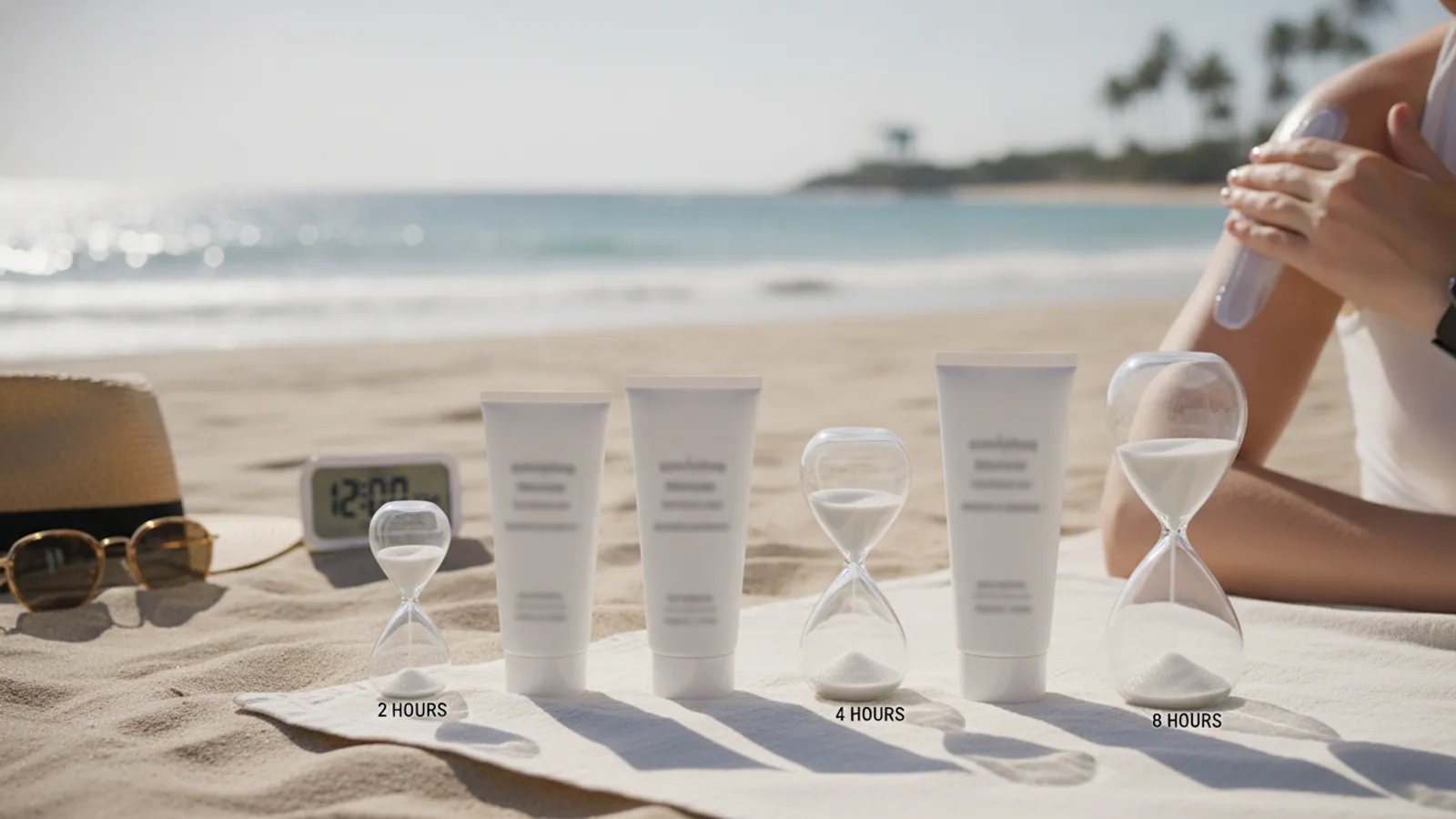
Now, let's switch from shelf life to application life. How long does sunscreen last on your skin? The universal rule recommended by dermatologists and health organisations like the NHS is to reapply sunscreen at least every two hours.
This is because the active ingredients in sunscreen break down with exposure to direct sunlight, losing their effectiveness over time. Furthermore, everyday actions like touching your face, wiping your skin, and the skin's natural oils can wear the protective layer away. The two-hour rule applies regardless of the SPF number; an SPF 50 does not last longer on the skin than an SPF 30.
Reapply More Often During Certain Activities
The two-hour rule is a baseline for average activity. You need to reapply much more frequently if your sunscreen is being physically removed from your skin. Always reapply immediately after:
- Swimming or being in the water
- Towel drying
- Sweating heavily (e.g., during sports, gardening, or on a very hot day)
Even products labelled "water resistant" are not waterproof. The label will specify how long the SPF protection is maintained while in the water, usually 40 or 80 minutes. After that time, or as soon as you get out and towel off, you must reapply.
Apply the Right Amount, 15-30 Minutes Before Exposure
For sunscreen to be effective, two things are critical: applying enough and applying it at the right time. Most people apply far too little sunscreen, significantly reducing the SPF protection they receive. As a guide, an average adult needs about 35ml, or a full shot glass, to cover their body. For the face and neck, aim for about half a teaspoon.
Additionally, chemical sunscreens (the most common type) need time to be absorbed by the skin to work properly. You should apply it generously to all exposed skin 15 to 30 minutes before you go out into the sun.
Common Problems and Solutions
Even with the best intentions, you might run into some common issues. Here’s how to troubleshoot them.
I can't find any date or symbol on the bottle.
If there is no expiry date or PAO symbol, the general industry standard is that the product is formulated to be stable for three years from its manufacture date if left unopened. However, without knowing the manufacture date, this is a guess. If the packaging looks old or you have no idea how long you've had it, the safest option is to replace it. The cost of a new bottle is minor compared to the risk of sun damage.
I got burnt even though I reapplied sunscreen.
This is a common and frustrating experience. It usually happens for one of a few reasons. First, you may not be applying enough product. If you don't use the recommended amount, you won't get the level of SPF protection on the label. Second, you may have missed some spots—common areas are the back of the neck, ears, tops of feet, and along hairlines. Finally, your sunscreen might have been expired, stored improperly (e.g., left in a hot car), or you may have sweated or wiped it off without realising.
My sunscreen separated. Can I just shake it back together?
No, you should not try to fix a separated sunscreen by shaking it. Separation is a clear sign that the emulsion—the formula that holds the oil, water, and active ingredients together—has broken down. When this happens, the ingredients are no longer evenly distributed. You cannot guarantee you are getting any protection, and the broken-down formula could also irritate your skin. It must be thrown away.
Advanced Tips for Sunscreen Effectiveness
Go beyond the basics with these expert tips to ensure you're getting the most out of your sun protection.
- Store It Correctly: Heat and direct sunlight are sunscreen's worst enemies. They accelerate the breakdown of active ingredients. Never leave your sunscreen in a hot car, on a windowsill, or in direct sun at the beach. Keep it in your bag, in the shade, or wrapped in a towel. At home, a cool, dark cupboard is the ideal storage spot.
- Choose Broad-Spectrum Protection: Always choose a sunscreen labelled "broad-spectrum." This means it protects you from both UVA rays (which cause premature ageing) and UVB rays (which cause sunburn). In the UK, look for a high SPF (at least 30) and a UVA star rating of 4 or 5 stars.
- Don't Forget Overlooked Spots: It's easy to miss areas when applying sunscreen. Pay special attention to your ears, the back of your neck, the part in your hair, the tops of your feet, and the backs of your hands. A lip balm with at least SPF 30 is also essential.
- Sunscreen Is Not a Suit of Armour: No sunscreen can block 100% of UV rays. It should be just one part of your sun safety strategy. Also seek shade during the hottest part of the day (11 am to 3 pm in the UK), wear protective clothing like a wide-brimmed hat and long sleeves, and wear sunglasses to protect your eyes.
Quick Reference: Reapplication Guide
| Situation | Reapplication Frequency | Key Consideration |
|---|---|---|
| A day in the office, sitting near a window | Apply once in the morning | Glass blocks UVB but not all UVA rays. A morning application is wise. |
| A day at the beach with swimming | Every 2 hours, AND after every swim/towel dry | Water washes sunscreen off. "Water resistant" is not waterproof. |
| Playing outdoor sports or hiking | Every 2 hours, AND after heavy sweating | Sweat carries sunscreen away from the skin, reducing its effectiveness. |
| A cool, cloudy day outside | Every 2 hours | Up to 80% of UV rays can penetrate clouds. The risk is still significant. |
How Long Does Sunscreen Last FAQ
Can I use last year's bottle of sunscreen?
Does a higher SPF mean I can reapply less often?
Is my foundation or moisturiser with SPF enough protection?
Does spray sunscreen last as long as lotion?
Final Checklist for Sunscreen Lasting Power
Use this final checklist to ensure your sunscreen is always ready to protect you effectively.
- Check the Expiry Date: Before applying, always check the printed "EXP" date on the packaging.
- Check the PAO Symbol: Know how many months your product is good for after opening.
- Label New Bottles: Use a permanent marker to write the date you opened a new product.
- Inspect Before Use: Give the sunscreen a quick check for any changes in texture, smell, or colour.
- Apply Generously: Use about a shot glass worth for your body and half a teaspoon for your face.
- Apply Early: Put sunscreen on 15-30 minutes before heading outside.
- Stick to the 2-Hour Rule: Reapply at least every two hours, regardless of SPF.
- Reapply After Water or Sweat: Always reapply immediately after swimming, towelling off, or heavy sweating.
- Store in a Cool, Dark Place: Protect your sunscreen from heat and direct sun to preserve its ingredients.