Retinal vs Retinol: Which Should You Choose?
A practical head-to-head comparison of Retinal and Retinol, covering quick verdict, key differences, category winners, buyer fit, and FAQ.
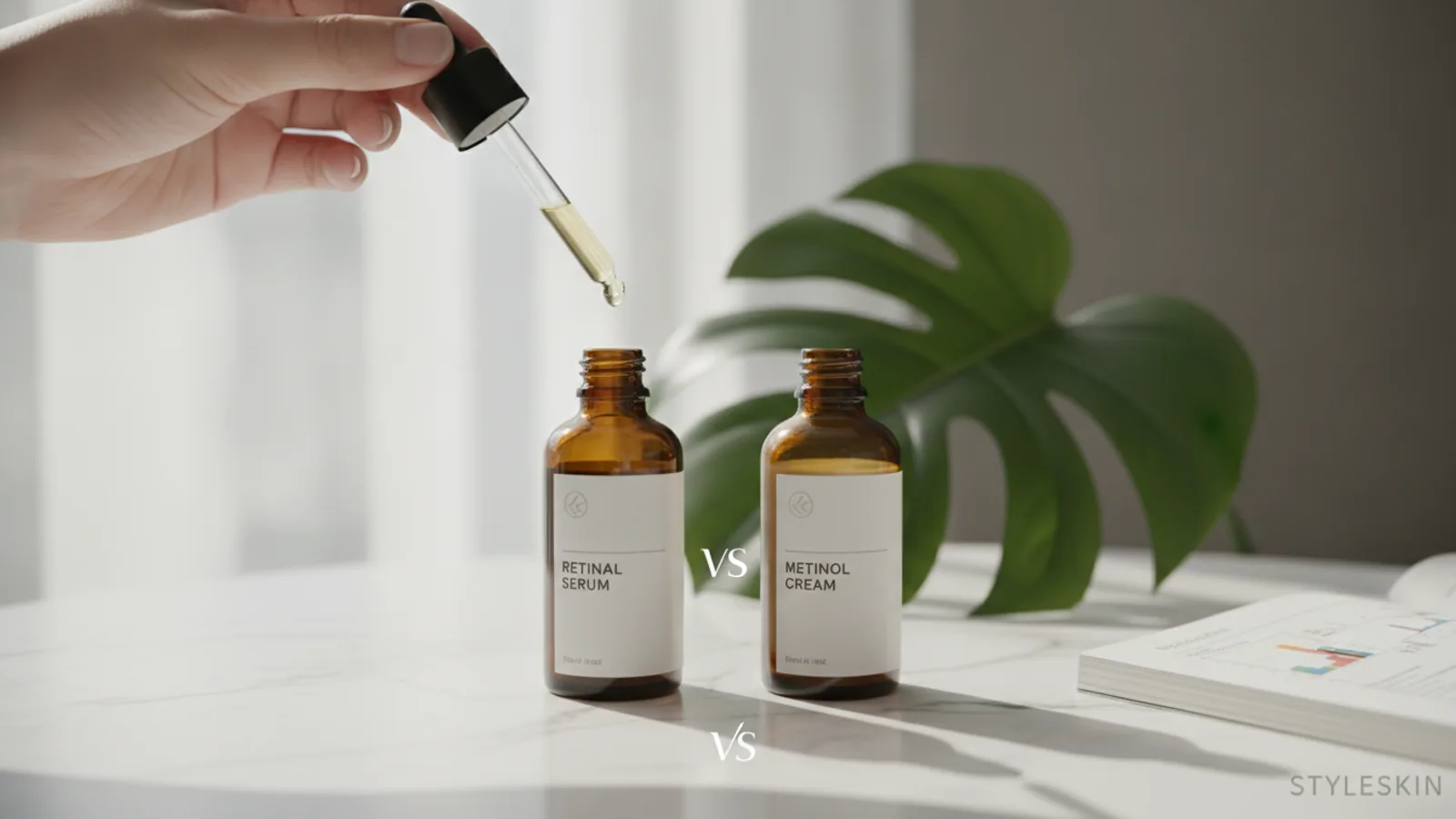
Retinal vs Retinol: Which Should You Choose?
Head-to-head comparison
Overall winner: Retinal for its faster, more potent results and unique benefits for blemish-prone skin.
Retinal is the superior choice for experienced users seeking rapid, visible improvements in fine lines, wrinkles, and skin texture. It acts significantly faster than retinol. However, retinol remains the gold-standard entry point for beginners or those with sensitive skin, offering gentle, steady results with a lower risk of irritation.
This comparison is based on the established science of the retinoid conversion pathway, analysis of current market formulations, and patterns in user-reported outcomes. We've assessed both ingredients on the metrics that matter for real-world results and usability.
Retinal (short for retinaldehyde) and retinol are both powerful Vitamin A derivatives, celebrated for their ability to accelerate skin cell turnover, boost collagen production, and visibly reduce the signs of ageing. The crucial difference lies in how your skin uses them. Your skin can only use the active form, retinoic acid. Retinol requires two conversion steps to become active, while retinal needs only one. This makes retinal inherently more powerful, but that strength doesn't automatically make it the best choice for everyone's skin or routine.
Option A
Retinal
- Best for faster anti-ageing results
- More powerful, one step from active form
- Higher potential for initial irritation
Option B
Retinol
- Best for retinoid beginners & sensitive skin
- Gentler, with a lower risk of side effects
- Slower, more gradual results
Head-to-Head Scorecard
Retinal vs Retinol: Key Differences
While both retinal and retinol fall under the "retinoid" umbrella, their performance is dictated by a simple but critical difference in their molecular structure. This difference controls how quickly and powerfully they can get to work on your skin. Understanding this "conversion pathway" is the key to choosing the right ingredient for your goals.
The retinoid family tree works like this: your skin cells can ultimately only use Retinoic Acid, the active form of Vitamin A that signals cells to behave younger and healthier. Over-the-counter products use precursors that your skin converts into retinoic acid.
- Retinol must first be converted into retinaldehyde (retinal). Then, that retinal is converted into retinoic acid. That's a two-step process.
- Retinal (retinaldehyde) is the direct precursor to retinoic acid. It only needs one conversion step.
Because retinal is just one step away from the active form, it works faster and more efficiently than retinol. This single-step advantage is the source of all its key differences: greater potency, faster results, and a higher potential for causing irritation as your skin adjusts. Furthermore, retinal has been shown to have direct antibacterial action, a benefit not associated with retinol, making it uniquely suited for those who are also concerned with breakouts.
Measurement Winners for retinal vs retinol
Measurement
Routine Fit
How easily can you integrate this ingredient into your skincare routine? This depends entirely on your experience level. For a complete beginner, retinol is far easier to adopt. Its gentler nature means you can start with a low concentration (e.g., 0.1% - 0.3%) a few nights a week and gradually increase frequency with a minimal chance of the dreaded "retinization" period of redness, flaking, and purging.
Retinal, by contrast, demands more caution. It's a significant step up in intensity. While modern formulations are often buffered with soothing ingredients, it's best suited for someone whose skin is already acclimated to high-strength retinol. It fits perfectly into an advanced routine for a user looking to escalate their results, but it can be a challenging starting point for a novice.
Measurement
Formula & Core Features
When we look at the core function and unique properties of each molecule, retinal has a distinct chemical advantage. Its primary feature is its position in the conversion pathway—being one step closer to retinoic acid makes it fundamentally more efficient at delivering anti-ageing signals to your skin cells. Studies suggest it can perform up to 11 times faster than retinol in stimulating collagen and elastin.
Beyond speed, retinal boasts a feature that retinol completely lacks: direct antibacterial properties. This makes it a multi-tasking powerhouse for those who struggle with both signs of ageing and adult acne or periodic breakouts. It can help regulate cell turnover to prevent clogged pores while also fighting blemish-causing bacteria. Retinol helps with acne indirectly by promoting cell turnover, but it doesn't have this direct antibacterial effect.
Measurement
Ease of Use
Ease of use is about forgiveness. How likely is an ingredient to cause problems if you're not an expert? In this regard, retinol is the clear winner. Its two-step conversion process acts as a natural buffer, slowing down its action and reducing the risk of overwhelming your skin. This makes it very user-friendly. You can find it in countless textures—creams, serums, oils—and it's simple to start low and go slow.
Retinal requires more respect and a more careful approach. Starting with too high a concentration or using it too frequently can easily lead to irritation, dryness, and peeling. While the results can be worth it, the "learning curve" is steeper. Users need to be more diligent about listening to their skin, buffering with moisturisers, and potentially dealing with a more intense adjustment period. Retinol is simply more accommodating for the average user.
Measurement
Value
Value is a combination of price and performance. Retinol dominates the market in terms of accessibility and price point. Decades of use mean the ingredient is cheap to produce and is featured in hundreds of products, from affordable drugstore staples to luxury creams. You can easily find an effective retinol serum for under £20, making it an excellent long-term value proposition.
Retinal is a more premium ingredient. It's newer to the mass market and is notoriously unstable, requiring more sophisticated and expensive encapsulation technologies to keep it effective in a formula. This translates to a higher price tag. While you could argue it offers more "bang for your buck" in terms of potency, its higher entry cost and more limited product selection make retinol the winner for overall budget-friendliness and accessible value.
Measurement
Buyer Confidence
Buyer confidence comes from proven results and a long track record. Retinol has been a cornerstone of dermatology and skincare for decades. There is a mountain of clinical data, scientific research, and millions of user reviews testifying to its effectiveness for long-term skin health. It's a known, trusted, and reliable quantity.
Retinal, while scientifically sound, is the newer kid on the block for consumers. Confidence in retinal is growing rapidly, especially among skincare aficionados who understand the science and are seeking the next level of performance. However, for the broader market, retinol's extensive history provides a level of reassurance and familiarity that retinal has yet to fully achieve. A new user can feel confident picking up almost any reputable retinol product, whereas choosing a retinal requires a bit more research.
Choose Retinal If
- You are an experienced retinoid user. If your skin is already well-acclimated to high-strength retinol (0.5% or 1.0%) and you're looking for more dramatic results, retinal is the logical next step.
- You want to see results faster. Due to its more efficient conversion process, retinal can deliver visible improvements in skin texture, fine lines, and firmness more quickly than retinol.
- You have concerns about both ageing and blemishes. Retinal's unique antibacterial properties make it an excellent two-in-one solution for tackling wrinkles and breakouts simultaneously.
- Your skin is resilient and not prone to sensitivity. While anyone can experience irritation, those with tougher skin are better candidates to handle the increased potency of retinal.
Choose Retinol If
- You are completely new to Vitamin A products. Retinol is the ideal starting point, allowing your skin to build up retinoid receptors gently and minimise potential side effects.
- You have sensitive or reactive skin. The slower, buffered action of retinol is much less likely to trigger redness, peeling, or inflammation.
- You are on a tighter budget. Retinol products are widely available at a fraction of the cost of most retinal formulations.
- You are focused on prevention and long-term maintenance. For maintaining healthy skin and preventing future signs of ageing, the steady, consistent use of a well-formulated retinol is a proven and effective strategy.
Final Verdict: Retinal vs Retinol
For its superior speed, potency, and unique blemish-fighting capabilities, Retinal is our overall winner. It represents the most powerful and efficient over-the-counter retinoid available today, making it the best choice for those serious about achieving transformative results.
However, this victory comes with a crucial caveat: the "best" ingredient is the one you can use consistently without compromising your skin barrier. For a significant portion of users—especially beginners and those with sensitive skin—that ingredient is unquestionably Retinol. It remains the most reliable, accessible, and user-friendly entry into the world of Vitamin A. It builds a fantastic foundation for skin health and delivers excellent results with patience and consistency.
The final choice isn't about which is "better" in a vacuum, but which is better for you right now. If you're ready for the fast lane and your skin can handle the pace, choose retinal. If you're starting your journey or prefer a gentler, steadier path, retinol is, and will remain, an outstanding choice.
Retinal vs Retinol: Which Should You Choose? FAQ
What's stronger: 1% retinol or 0.1% retinal?
The 0.1% retinal is significantly stronger. A common rule of thumb is that retinal is about 10-11 times more potent than retinol. Therefore, a 0.1% concentration of retinal provides a much stronger effect than even a 1.0% concentration of retinol.
Is retinal the same as Tretinoin (Retin-A)?
No. Tretinoin is pure retinoic acid, the active form of Vitamin A that skin cells can use directly. It is a prescription-only medication and is far more powerful (and potentially irritating) than any over-the-counter retinoid. Retinal is the closest OTC ingredient to prescription strength, as it's the direct precursor to retinoic acid, but it is not the same thing.
Can I use retinal and retinol together in my routine?
No, you should not use them together. Both are powerful active ingredients, and using them at the same time would be highly irritating and damaging to your skin barrier. Choose one or the other based on your skin's needs and tolerance.
How long does it take to see results from retinal versus retinol?
With consistent use, you might start to see initial results from retinal in as little as 4 to 6 weeks. For retinol, the timeline is typically longer, often taking 8 to 12 weeks or more to show noticeable improvements. Significant, long-term changes for both ingredients can take 6 months to a year.
What are the main side effects of using retinal?
The side effects of retinal are the same as those for retinol but can be more pronounced due to its higher potency. They include dryness, tightness, redness, peeling, and a possible initial "purging" period where acne may temporarily worsen. These can be managed by starting slowly (2-3 times per week), using a small amount, and applying a good moisturiser.
Can I use Vitamin C with retinal or retinol?
Yes, you can, but it's best to separate them. The standard advice is to use your Vitamin C serum in your morning routine (as it's a great antioxidant to protect against daily environmental damage) and use your retinal or retinol product in your evening routine, as retinoids can make your skin more sensitive to the sun.